Showing posts with label tips. Show all posts

10/14/2016

Adding type instead of an image.

Sometimes I like to add some wording to a block that has a theme.  Such is the case of this block with a rabbit theme.  This little poem was too long to stitch so I used my favorite method of adding words to a block...

Here it is on the entire block and it is the perfect final touch.


On my current project inspired by my anniversary sampler, I wanted to use the original words on the sampler.  My original plan was to cross stitch the words petit point but it just wasn't going to work.


So I scanned it and printed it on paper-backed cloth made for image printing.  I use a cotton variety but there are also silk sheets available.  I personally like the cotton better because it has more body and is more dense.  I just rough cut what I want to print and will trim it after I have the Wonder Under on the back.

Wonder Under is a fusible paper-backed web made by Pellon.  It comes in two weights and I prefer the heavier one.  It is readily available at fabric stores and is usually shelved with the interfacings.  It is widely used by stitchers doing applique.

I want to mount my wording  on felt.  The problem is that even the denser cotton is very transparent once the paper backing on the image is removed.  First if you are using a colored felt, the color will show through and spoil the image.  Second often the fibers of the felt might also show through when attached to the fabric with the image.

To get around that problem I attached the image FIRST to a piece of plain white cotton or muslin.  I use Wonder-Under to attach it.

Here are the materials assembled.... image on fabric, wonder-under, cotton square and colored felt.

After the image is backed with Wonder Under and ironed to the cotton/muslin square I trim it to size and attach ANOTHER piece of wonder-under and iron it to a larger piece of felt.


 Once it is attached to the felt I trim again leaving about 1/8" of felt exposed.  And it is looking like this.. There is nothing turned under so it will lay flat and the wonder-under keeps any edges from fraying.  Now it is ready to attach to my block.

Sometimes I use trim on the edges or just attach with tiny stitches and/or beads.  Here I am using trim across the top and beading around the rest of it.


The smaller image of our name I just attached with tiny stitches.


The first time I added a poem I just printed it on silk and turned the edges under.  It did not lay flat and the needlework underneath showed through.  I was not happy with it.  It was lumpy and wrinkled.


When I was working on my Morris book I wanted it to be "interactive" with flaps that could be lifted with an image underneath.  The flap needed to be even more firm so I added another step with two pieces of felt.

When you lift this flap there is a wild turkey underneath.  I have these flaps throughout the Morris book.   I added the flaps with beads as "hinges."


When I did the book about my sheep I used the same technique to add a poem, names, and other information.


I know someone will write and ask how I got the curve in the type of the rabbit poem.  Years and years ago I downloaded a little free software program called "Type Twister"  I just love it but it is no longer available and it now only works on my old computer. It is a fabulous little program and so sorry it's not compatible anymore.


6/16/2016

A tip to file away!


Quite by accident I discovered you can modify the width of the end result of this ruched ribbon no matter what the width of the ribbon.  The book's instructions have you mark the gathering lines according to the width of the ribbon.... which I did (A) and the end result was too wide....


But if I narrowed the spaces between the triangles I got a much narrower end results.

1/18/2016

Cut-away transfer AGAIN!!!


Of all the things I have shared I feel my method of cutaway transfer is the absolute niftiest.  If I want to transfer a design or image to a fabric with texture (velvet, linen, lace, etc) or a fabric that has a prominent print or    fabric that is too special to make any mark on, I ALWAYS use this method and apply it to the BACK of the fabric.  There is already a tutorial on this blog but I will go though the steps once again...

Since I work from the back of the fabric  I need a reverse image of my design.  Then I apply an iron-on interfacing to the back of the fabric.   I mark my image into sections. 

I then cut out the reverse image I want to transfer and lay it on the interfacing and trace around the whole image.

Please note:With birds I do not cut out the beak.  I always apply the beak at the very last.


Then I start cutting off the smallest outside bits.... in this case the top of the head and the tail.  Then I place the image back on the interfacing and make a line where I cut away.


I just keep cutting away bits and marking where I cut.


Eventually I was down to the wing which was the last part to cut up.


You can see what is left of the paper image as I cut it all up into small bits.


Then I do some basting with a contrasting thread on the lines...


And when I turn it over  I have my bird on this velour fabric.  There are no marks or chalk  or tissue paper to deal with and the basting stitches are easy to remove as I go along.  You would be amazed how easily and quickly you can transfer even very complex images this way.

So I have gathered my metallic gold threads and sorted them from light to dark and will soon show you how I start the stitching.

11/05/2015

Squish the centers!!!

I just love this piece of ribbon embroidery and I would highly recommend anyone EVER contemplating doing daisies (or daisy-like flowers) to study and keep this photo.  You should notice right away that each flower is different but you know each is a daisy.

And not a single one looks like a fried egg...


Over and over again I see daisies (or daisy-like flowers which includes aster, cornflowers, etc.)
looking like a mass of fried eggs staring right at you...


One trick to force yourself to avoid this is when you draw the centers, flatten or squish them and then draw a irregular shape around the center....and do each one different.  This will force you to add variety to the shapes of the flowers.

At our Sit & Stitch meetings we are doing ribbon flowers with a 4" hoop to use in hexies.  At the last get-together I had them do blue cornflowers using this little trick... This one is by Kathy Streeter and she has already finished the hexie as well.  She not only used blue centers instead of yellow centers, she added a second row of petals in a different shade of blue.


This one is by Teresa Smick and is still a work in progress.  She used a variegated ribbon and also added a second row of petals which added depth and interest. PLEASE NOTE: every center is an irregular shape.

Both these exquisite examples just ooze interest and variety to a simple composite flower... so remember "squish " the centers...


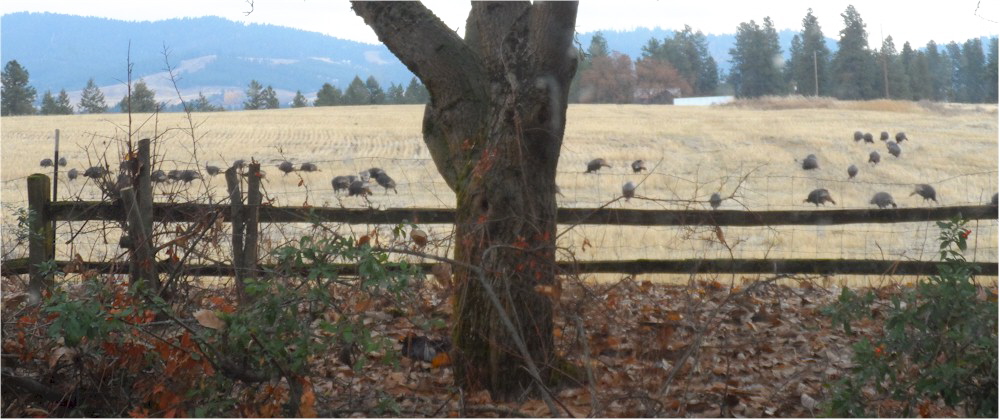
The wild turkeys have flocked up for the winter and are regular visitors now...

11/12/2014

Contrast with value, dimension, size and texture - post 1490

At the CQ Adventure in 2011 Cheryl A. had a tone-on-tone RR block which was all greens. She was looking for ideas for adding contrast without depending on other colors.  Several of us thought of green critters to use as a focal point...   we came up with a lot...  grasshoppers, alligators, frogs, turtles, lizards and various bugs.  But I knew if  I ever had to do a monochromatic green block I'd add a parrot.  So when Theresa color blocks arrived I was delighted the green one was available.

As you can see I have already added my handsome parrot.... now the challenge will be to add more interest and variety using only greens.... I want to do that with contrasts in
value, size and texture.

It would be especially difficult to mark on the wool so AGAIN I have turned the block over and drew the leaves on the back and basted the lines to show through to the front.  Now I will fill in foliage, berries etc. with various greens and various materials.

 I did an extensive post   in 2011 on adding variety and interest with contrasts in dimension, size, and texture...  You may find it interesting.

If I hadn't done a parrot, my second choice was a John Deere tractor...

11/08/2014

Tips & tricks for awkward corners!


Some times when you are piecing a block you quite often end up with an awkward   corner really too small for a motif treatment..  And Mary's block is a good example except that she has four such corners.  I could put a little motif in each corner but that would not help the problem. 
 
I have a bag of tricks for just this very thing...


1.  I try to bring the patch into block by moving some of its color and adding something that makes the shape less defined.  This time I chose flowers the same shade as the block and moved some down onto the purple along with some foliage.


2. For the upper right corner I chose something bold to attach to it to make it work as a larger unit.  Notice how it overlaps the seams to help include the small patch into the block as a whole.


3. Another option is bring some element from the block down into that patch and it just disappears..


4. Sometimes rather than make a small patch seem larger I divide and conquer to make it smaller... With two or more pieces of trim you can downsize a patch.  On fact it becomes so small it hardly seems like a patch at all.


So now there is some variation in the four small corners which were so similar in size and they all have their own personality..

 
5. Another technique I use often and could have used here is to add a coordinating trim (usually ribbon) to make a block larger.    In this case I could have added a wide purple ribbon to the little purple corner patch which would have doubled its size and made the turquoise  patch smaller.   I use this technique often...


And now the tail...  I didn't want to mark on top of the block so I turned it over and sketched a tail.  I already had the peacock body in place so positioning it was no problem.  Then I did quick basting stitches over my lines.


Then I could turn it back over and embroider over my basting stitches.  I use this technique over and over and over again and have long meant to write a proper tutorial on it... Mary Corbet had an article recently on transferring designs and working from the back wasn't mentioned so I am determined to get a tutorial worked up and send it to her....


So I used all the colors in the block in the peacock tail and carried it right down into the pesky little corner patch!!!!!


8/15/2014

Two Useful Tips!!

I know I blogged earlier this summer about the Berol R-77 Ellipse Master but if you want to add a most useful and versatile tool to your arsenal of seam templates, this should be at the TOP of the list.  I started Lisa's blocks this morning and am using it.  It is so much fun. By combining different sizes ellipses and changing the direction, the possibilities are endless.  The cheapest place to find one is on E-Bay.

When I am stitching my little birds I like to outline their eyes with a white ring...  Now we are talking REALLY small.  The eye is the size of a #15 bead or about 1/16 of an inch.  Trying to use an outline stitch was impossible that tiny but I found if I stitched a thread at a time AND alternate  from side to side on the circle, I could get a very tidy tiny circle.... I love it when I find a solution for a irritating problem and this is one I'll use all the time...


DH is out of town for 3 days and this is the first time I've been alone that long since the shooting.  Since he is gone often I'll have to get used to it...  BUT I am locked in and except to go bathe my mother tomorrow I'm keeping it that way...

We are adding an alarm system but since we are so isolated  it is pretty much useless..and there only one patrol car for our whole part of the county...burglers realize that they can do whatever and be long gone before anyone can arrive.  But at least if the alarm is ringing when we come home, we won't go into the house.

4/05/2014

Cording Technique


 I went to see Allie on April 6th and have worked non stop on the suffrage piece ever since and now on the last step...the corners. I basted the batting, quilted all the layers,  did border, border lace, border trim and then proceeded to add the cording around the whole piece...Here  I ran into problems... The cording has 3 ply and a good deal of elasticity.  If stitched too tight it causes the piece to buckle and stitched too loosely it causes the piece to have a wavy edge... plus you have to watch it closely as the twist will twist!!!  I didn't want  the couching stitching to show so I was "floating " stitches between the strands.
 
I initially did it too tight and had to take a good deal of it off and redo it...   Found if I pinned it like so I could avoid the twisting and also keep it flat.  I was worried I wasn't going to have enough cording on my spool and I made it by about 1"... too close for comfort.
 
 
I found if I inserted the needle at a 45 degree angle from the top (between the strands) and then moved 1/4" to the left and went straight back through that NO stitching showed on either side of the cording... Always working at 45 degrees from the top...


3/24/2014

"1,2,3, prick" did the trick!


In order for my suffrage quilt to qualify for entry in some shows it must be quilted through at least 3 layers... so I set about to do that.
Goals:
To have virtually NO stitching be visible on top of the quilt.
All the stitching showing on the back of the quilt to be tiny, even, and visible.
Problems:
I haven't hand quilted like this for 30 years...
My hands are crippled and my eyes are shot.
When I inserted the needle in with teeny stitch on top I couldn't see where to come up. (I started using transparent thread but it reflected light so I took it all out and went to black thread.)

So here is what I did:


I decided to use tiger tape (9 stripes to an inch) as a guide as I use it on my CQ seams and love it.
At first I tried using my thumbnail on the reentry mark. But if I lost focus and moved my finger at all I lost my reentry point...


So after I brought my needle up, I counted over 3 strips and made a prick... went down on the next mark and up on the mark with the prick.  Even if I left the frame I could always come back and see where I was. 

At first I actually counted 1,2,3, prick but soon it came automatically and the quilting went quite rapidly.  You can see a strip here with the pricks and how visible they are.  I could reuse a pricked strip 2 or three times.


This morning I took it off the frame to rotate it as I have problem stitching vertically and am quite pleased with the result. There is NOT A SINGLE QUILTING STITCH visible on top of the quilt but all the quilting on the back of the quilt is even and tiny. Well quite good enough considering....

With my eyesight problems I can definitely see a use of pricking strips in CQ seam work.


Related Posts Plugin for WordPress, Blogger...

Popular Posts